Join The Community Efforts
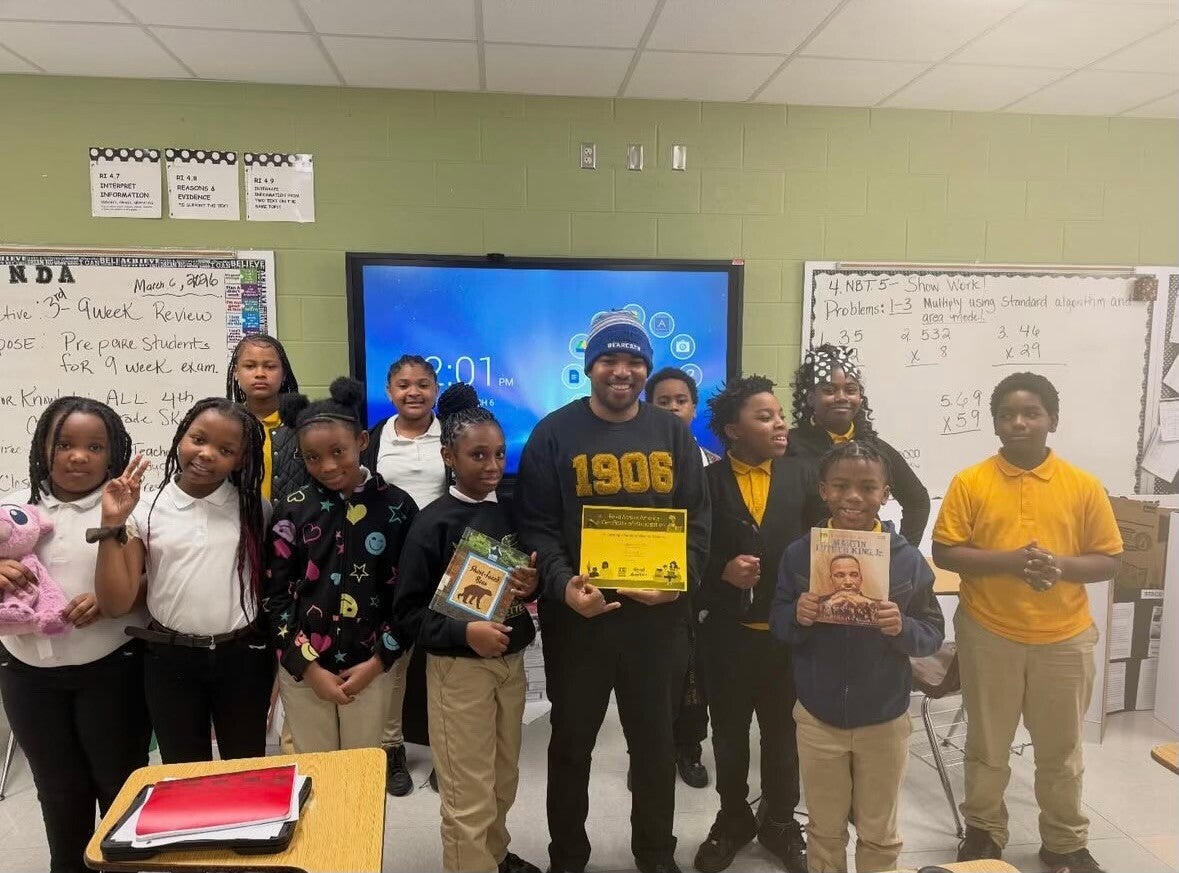
Making A Difference
Reading to the youth is impactful for the community because it helps children develop strong literacy skills, imagination, and confidence at an early age. When young people are exposed to books, they are more likely to perform better in school and become lifelong learners. Reading also introduces them to new ideas, cultures, and ways of thinking, which helps them grow into open-minded and educated individuals. When the youth are educated, the entire community benefits because educated individuals are more prepared to solve problems, contribute positively to society, and inspire future generations. Reading to the youth also shows them that their community cares about their future, which can motivate them to strive for success

Keeping Waters Pure
Cleaning up trash in the community is impactful because it creates a cleaner, safer, and healthier environment for everyone. A clean community reduces pollution, prevents harm to wildlife, and lowers the risk of illness caused by unsanitary conditions. It also builds pride among community members and encourages people to take responsibility for their surroundings. When people see others taking action to improve the environment, they are more likely to join in and maintain the cleanliness of shared spaces. A well-maintained community also creates a positive image, which can attract visitors, businesses, and new opportunities.

Spreading Love
Spreading love throughout the community is impactful because it strengthens relationships and promotes unity among people. Acts of kindness, encouragement, and support can improve mental health and create a sense of belonging. When individuals feel valued and cared for, they are more likely to help others and contribute positively to the community. Love encourages cooperation, reduces conflict, and creates a more peaceful environment. A community built on compassion and respect allows individuals to grow, overcome challenges, and work together to create a better future for everyone.
Dr. Zhang Guidance
Working with Dr. Zhang, who is an experienced engineer, has helped me gain valuable exposure to important engineering tools and instruments throughout this internship. Through hands-on learning, Dr. Zhang has introduced me to various technical tools and shown me how they are used to solve real-world engineering problems. This experience has increased my confidence and strengthened my understanding of how engineering concepts are applied in practice. As a result, I feel more prepared and comfortable pursuing graduate school, because I have already developed familiarity with the types of tools and equipment commonly used in engineering environments. The guidance and mentorship I have received have helped build a strong foundation that will support my success in advanced studies and future engineering work.
Conservation of Momentum


Centripetal and Centrifugal Force
In the Centripetal Force lab, I explored how centripetal force depends on mass, speed, and radius in circular motion. I used engineering tools such as a force sensor, photogate, rotating apparatus, and PASCO Capstone software to collect and analyze data. By systematically changing one variable at a time while keeping others constant, I applied experimental design principles commonly used in engineering. I created graphs of force versus mass, velocity, and radius, and used curve fitting techniques to identify relationships between variables. This allowed me to verify the equation for centripetal force and interpret the physical meaning of the slope in each graph. Through careful calibration and measurement, I ensured accuracy and demonstrated how engineers test and validate mathematical models in physical systems.
Vibrating Strings
In the Vibrating Strings lab, I studied standing waves and the relationship between tension, frequency, and wavelength in a stretched string. Using tools such as a string vibrator, force sensor, and PASCO Capstone software, I generated and measured wave patterns under different conditions. I applied engineering skills like system tuning and parameter control by adjusting tension and frequency to produce clear standing wave patterns. I then analyzed the data by graphing tension against frequency squared and wavelength squared to linearize the relationships. This allowed me to confirm theoretical equations and determine properties such as the string’s mass density. Overall, this lab demonstrated how engineers analyze wave behavior and optimize systems through experimentation and mathematical modeling.


Ballistic Pendulum
In solving the ballistic pendulum experiment, I applied engineering tools and skills by combining precise measurement techniques, experimental setup, and analytical problem-solving. First, I used physical tools such as a mass balance to accurately measure the mass of both the projectile and pendulum, and a ruler or measuring device to determine distances like the center of mass and pivot points. I also ensured proper system design by securely clamping the apparatus to minimize external vibrations, demonstrating attention to experimental control and reliability. Using data collection skills, I recorded multiple angle measurements from repeated trials to reduce random error and improve accuracy through averaging. I then applied engineering analysis by using principles of conservation of momentum and energy to model the system and calculate the projectile’s velocity. Additionally, I evaluated sources of error—such as friction, air resistance, and measurement uncertainty—and considered how they impact results, which reflects critical thinking and validation skills. Overall, this process demonstrates how engineering integrates hands-on tools, mathematical modeling, and data-driven reasoning to solve real-world physics problems
Create Your Own Website With Webador